
Airflow and Damper Control Principles in Tunnel Kiln Firing Automation for Fired Brick Lines
Automated tunnel kiln operation for fired brick production relies on precise airflow management and pressure balance control. Every component including the exhaust fan, hot air extraction fan, kiln car bottom sealing, sand seal, balance fan unit and low-temperature preheating hatch dampers follows fixed thermal rules. Mastering these control principles helps operators tune the kiln steadily, avoid fire line disorder and reduce brick defects such as underfiring and overfiring.
The exhaust fan creates the main negative-pressure flow inside the kiln. Hot flue gas flows from the firing zone towards the preheating zone, opposite to the forward movement of green bricks. Air drawn by the fan supplies oxygen for internal coal combustion, and waste heat in flue gas is reused to dry green bricks.
During preheating up to ignition temperature, heat transfers from flue gas to green bricks. Once coal ignites, temperature climbs to the firing peak. The exhaust air volume must match coal feeding rate, securing suitable oxygen so that 70%–80% embedded coal burns out in the firing zone. Too little air leads to poor combustion and unstable fire line. Excessive airflow extracts too much heat, resulting in low overall kiln temperature even if the fire moves forward quickly.
Separately, the hot air extraction fan harvests heat only from the cooling zone for drying purposes and does not deliver combustion oxygen. Increased hot extraction removes heat faster and cools down the whole kiln chain from cooling zone backward to preheating zone. Reduced extraction retains heat inside the kiln. Its airflow direction is opposite to the exhaust fan, competing for total airflow capacity and lowering kiln temperature. If the firing zone sits close to the hot extraction outlet, high extraction volume locks fire progression and creates overfired bricks in the stack center. With fixed cooling blower air supply, excessive hot extraction will cause oxygen shortage.
The kiln car bottom channel is a dedicated pressure balancing duct. Wind baffles and sand seal troughs isolate this duct from the kiln firing chamber. Pressure balance between car bottom and kiln interior prevents cross-leakage. Upward air leakage causes underfired bricks; downward gas leakage damages kiln cars. Kiln car bottom temperature must stay controlled within 70℃–100℃.
Coarse mung-bean sand is filled for sand seals. Fine sand is vulnerable to being blown away. Coarse sand is spread evenly along the trough by kiln car baffles to block air bypass between the kiln and car bottom.
The car-bottom balance system is built with balance fans and pressure sensors. Fully negative-pressure tunnel kilns use suction balance fans. Kilns fitted with discharge-end cooling blowers run negative pressure in preheating zones and positive pressure in cooling zones, requiring one suction fan and one blower fan. Variable frequency control synchronizes car-bottom pressure with kiln pressure in front and rear kiln sections. Mechanical balance gates can generate negative pressure but cannot support automatic closed-loop adjustment and cannot work under positive pressure.
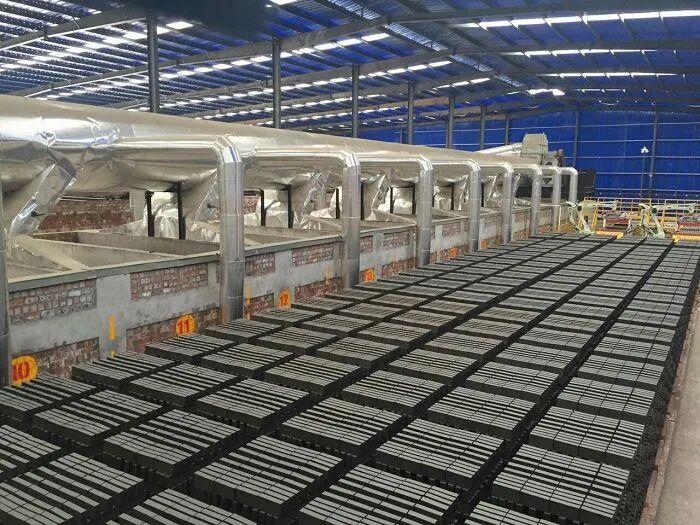
Low-temperature preheating hatch dampers cover kiln positions 1–10, up to 560℃. Total damper opening controls overall airflow, and different opening combinations adjust temperature distribution across these early kiln positions.
Each hatch damper can lift up to its radius height. The number of dampers is calculated by taking the square of the diameter ratio of the main flue and single damper. With a 1.2 m main duct and 0.4 m damper, the ratio is 3, requiring 9 dampers for full opening or 18 dampers (9 pairs) at half opening. This layout minimizes pressure loss on dampers.
When fans run with VFD speed regulation, hatch dampers should be fully opened so fan energy is not wasted on throttling resistance. Damper pattern and opening define fire speed and hourly output. Independent damper curves are needed for standard bricks, perforated bricks and hollow bricks. Parameters also differ for wet green bricks and dried green bricks. When fan speed hits the lower limit for dryer airflow while fire speed remains too fast, operators must adjust damper shape and opening to maintain stable drying air pressure and flow rate.
The basic rule of damper operation: raising a hatch damper allows more hot flue gas to pass through that position. More flue gas equals longer heat exchange and higher brick temperature.
FAQ
Q1: What is the safe temperature range for tunnel kiln car bottom?
A1: The recommended temperature range for the kiln car bottom is 70℃ to 100℃, to protect sealing components and kiln car metal structures.
Q2: How do hatch dampers affect tunnel kiln temperature distribution?
A2: Hatch dampers control the flow volume of hot flue gas passing each kiln position. Larger opening brings more flue gas, stronger heat exchange and higher local temperature.
Q3: Why should we fully open hatch dampers when using VFD fans?
A3: Fully opened dampers eliminate throttling pressure loss. If dampers are partially closed while fans run at low frequency, fan power will be wasted overcoming damper resistance and the whole airflow system becomes unstable.