Picking out an auto brick machine isn't just about comparing prices or eyeballing a production rate. You really need to find something that matches your raw materials, power setup, available floor space, and your daily output goals. I’ve seen brochures with pretty lines of machines that look amazing, but in reality, they might struggle with damp soil, inconsistent aggregates, or switching between different products. The devil’s in the details, for sure.
Here’s a quick guide to help you out: check your production targets first, then take a close look at the forming and hydraulic systems. Make sure the machine is compatible with your materials, review how automation fits into your process, and don’t forget to compare energy consumption. Also, see what kind of maintenance support is available and be cautious about trusting supplier claims blindly. Always ask to see a real, running machine—not just glossy pictures of finished bricks. Watch how bricks come out of the mold, examine their finish, and ask how quickly worn parts can be replaced. Little things like this can save you a lot of trouble down the line.
Daniel Hart, an equipment consultant, often reminds people, 'Buy the machine that makes the bricks you need every day, not just the one with the fanciest numbers on paper.' Keep in mind, that quote’s just a draft—it’s not official until verified by a real expert. The same goes for capacity claims in advertisements. Always request a written test plan and clarify exactly how the supplier measures output. An auto brick making machine should really be a good fit for your operation, not something that forces your team to change their workflow based on vague promises. Sadly, some buyers miss the point and get caught up in the hype. So, my advice? Slow down a bit and really do your homework—you’ll thank yourself later.
Set Strength Requirements Using ASTM C90’s 2,000 psi Average Benchmark
When buying an auto brick machine, set strength targets before comparing production speed. ASTM C90 specifies a 2,000 psi average compressive strength for loadbearing concrete masonry units. It also recognizes a lower individual-unit limit of 1,700 psi. These figures are not decorative numbers. They affect cement content, vibration, compaction, curing, and machine pressure.
Ask whether the machine can produce consistent density across each batch. A powerful hydraulic system alone cannot guarantee strength. The American Concrete Institute emphasizes that water-cement ratio, consolidation, and curing strongly influence concrete performance. In practice, uneven moisture can leave one brick dense and another weak. That problem may not appear during a quick visual inspection.
Test the finished units through ASTM C140/C140M procedures, including compressive strength, absorption, and dimensional checks. Keep batch records with mix proportions, cycle time, mold settings, and curing temperature. A useful trial should test several production runs, not one attractive sample. A perfect-looking brick can still fail. I would also allow a safety margin above 2,000 psi, because field conditions are rarely perfect. The honest question is not, “How many bricks per hour?” It is, “How many compliant bricks can this machine produce repeatedly?”
Match Molds to Common 390 × 190 × 190 mm Block Dimensions
7 Tips for Buying an Auto Brick Machine
Match Molds to Common 390 × 190 × 190 mm Block Dimensions
When buying an Auto Brick Laying Machine, begin with the mold, not the machine frame. The common 390 × 190 × 190 mm block requires accurate cavity dimensions. A small error can create uneven edges, poor stacking, or difficult demolding. Ask the supplier for a measured mold drawing. Do not rely only on catalog images.
Check whether the mold produces solid blocks, hollow blocks, or both. Each design needs different internal cores and vibration settings. Inspect the mold steel, welding quality, and replaceable wear parts. A production test is valuable. Measure fresh blocks with calipers after curing, not immediately after pressing. Concrete may change slightly during drying.
I once focused on output speed and ignored pallet size. That was a costly oversight. The mold fit, but the pallets did not move smoothly through the line. Review mold length, block height, pallet clearance, and lifting space together. Also test your local mixture, because moisture changes block density and surface quality. A reliable supplier should provide trial data, maintenance instructions, and realistic cycle times. Be cautious with impressive numbers that lack testing conditions. Leave room for human error, because operators still adjust materials and molds every day.
Compare Product-Specific Cycle Times, Often 15–25 Seconds
7 Tips for Buying an Auto Brick Machine?
A fast cycle is not automatically a productive cycle. When comparing an Auto Clay Brick Kiln Machine, examine the product-specific molding time, not only the advertised headline. A 15-second cycle can theoretically produce 240 cycles per hour. A 25-second cycle produces 144. Real output falls when loading, mold cleaning, material refilling, and pallet changes are included.
Ask for test records using your clay mix, target brick size, and moisture level. The European Commission’s Ceramic Manufacturing BREF identifies drying and firing as major process stages affecting energy use and production stability. A machine may mold quickly, yet wet bricks can crack during drying. That is a costly surprise. Request cycle data from at least three trials, not one demonstration.
Look closely at the rejected-piece rate. A five-second saving means little if inconsistent pressure creates chipped corners. For example, at 90% effective availability, a 20-second cycle gives about 162 usable cycles per hour before quality losses. Confirm how the supplier measured availability. Was maintenance included? Were operators experienced? I have seen specifications that looked impressive but ignored changeover time. That omission matters.
Compare mold replacement time, pressure consistency, and automatic fault records. Independent inspection reports, maintenance logs, and documented production trials strengthen your decision. The 2023 International Energy Agency industrial analysis also highlights the importance of improving process efficiency, not merely increasing machine speed. Faster is useful. Stable is better.
7 Tips for Buying an Auto Brick Machine? – Compare Product-Specific Cycle Times, Often 15–25 Seconds
Cycle times below are indicative planning examples, not guaranteed specifications. Actual times depend on the machine, mold, mix, product dimensions, and operating conditions. Request a timed production test using your intended product and raw materials.
| Buying tip |
Product or operating factor |
Indicative cycle-time comparison |
What to verify before purchase |
| 1. Compare times for the exact product |
Standard solid or hollow concrete block |
Often around 15–25 seconds per forming cycle on automatic equipment; configuration and product size matter. |
Ask whether the quoted time covers filling, vibration, pressing, and mold release—not just press time. |
| 2. Identify the mold configuration |
Pavers, which are generally shorter and flatter than blocks |
A cycle may fall within roughly 15–25 seconds, but some product and mold combinations take longer. |
Confirm cavity count, mold dimensions, changeover time, and whether the sample mold matches your intended paver. |
| 3. Test complex product shapes |
Interlocking pavers, textured units, or products with deeper features |
May require more filling or compaction time than a simple, flat product; do not assume a standard-block cycle applies. |
Request a trial with the actual mold and inspect filling consistency, edge definition, and finished dimensions. |
| 4. Check the mix and compaction process |
Moisture content, aggregate grading, vibration, and pressing |
Cycle times can change when the mix needs additional filling, vibration, or compaction to meet quality requirements. |
Use your production mix during the test; check density, surface finish, dimensional consistency, and handling strength. |
| 5. Distinguish cycle time from hourly output |
Cycle duration and number of products per mold cycle |
At 15–25 seconds per cycle, the theoretical rate is about 144–240 cycles per hour, before downtime and other production losses. |
Multiply cycles per hour by confirmed pieces per cycle, then ask for realistic net output after normal stoppages. |
| 6. Include handling and curing in capacity planning |
Pallet supply, transfer system, stacking, and curing space |
A fast forming cycle does not guarantee matching line output if pallet return, product transfer, or curing capacity is limited. |
Check synchronized line capacity, pallet circulation, staffing needs, and the curing arrangement for your products. |
| 7. Get a written, measurable acceptance test |
Factory trial and performance commitment |
A stated 15–25-second cycle is useful only when the product, mold, mix, and test conditions are clearly defined. |
Record average cycle time, accepted pieces per hour, reject rate, and test duration in the purchase agreement. |
Practical comparison: Use the same product drawing, mold specification, raw-material mix, and output-quality criteria when comparing cycle-time claims from different suppliers.
Calculate Output from Mold Cavities and Cycles per Hour
A machine’s advertised output is only a starting point. For a Semi Auto Brick Making Machine, calculate production from cavity count and hourly cycles. Use this formula: hourly output = cavities × cycles per hour × utilization. An eight-cavity mold completing 15 cycles hourly gives 120 green blocks. At 90% utilization, practical output falls to 108 blocks. That gap matters. UNIDO’s International Yearbook of Industrial Statistics 2023 separates installed capacity from actual production, offering a useful warning for equipment buyers.
Do not confuse cycle time with finished sales. Allow for startup, mold cleaning, mix adjustments, pallet changes, and minor stoppages. An eight-hour shift would yield 864 green blocks in this example. If quality inspection removes 5%, saleable output becomes about 821 blocks. That 5% is an assumption, not a promise. Concrete masonry standards also require consistent dimensions and strength, not merely volume. ASTM C90 is widely referenced for concrete masonry units, so testing should remain part of the calculation.
Ask suppliers for recorded cycle logs, not optimistic demonstrations. Request results using your block size, mix moisture, and curing schedule. Measure three shifts. Then compare rated output with saleable output. The 2024 Global Cement and Concrete Association roadmap also stresses process efficiency and measured resource use. One uncomfortable truth remains: faster cycles can increase rejects, downtime, and maintenance. Your spreadsheet may look precise. The factory may not.
Check Automation from Batching Through Palletizing
7 Tips for Buying an Auto Brick Machine?
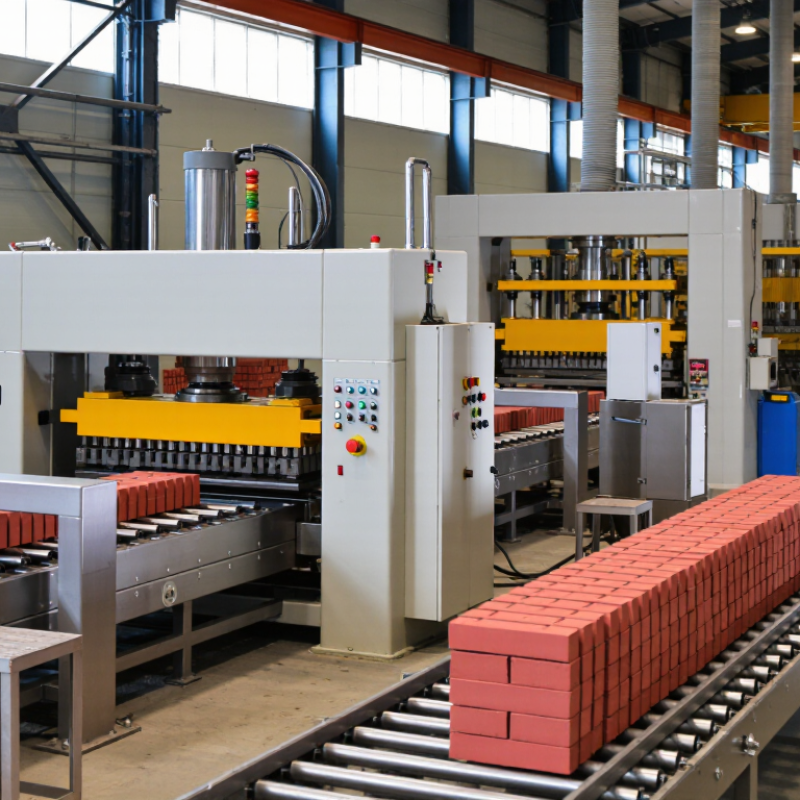
Automation should be checked from batching through palletizing, not only at the press. Inspect the aggregate feeders, cement dosing, water control, mixer, press, curing transfer, sorting, and palletizer. Ask for repeatability data at different moisture levels. A stable recipe means little if wet sand changes every morning. I have seen excellent presses slowed by inaccurate feeders and poorly tuned conveyors.
Check whether sensors record batch weight, moisture, cycle time, rejects, and downtime. The International Federation of Robotics reported 553,052 industrial robots were installed globally in 2022, showing wider acceptance of automated production. However, more automation does not guarantee better output. Request a live factory test with your materials, including start-up, emergency stops, product changeover, and pallet alignment.
Palletizing deserves careful attention. Confirm layer accuracy, pallet detection, strap or wrap integration, and safe recovery after a jam. The U.S. Department of Energy notes that compressed-air leaks can waste 20% to 30% of compressor output, so inspect valves, cylinders, and air lines. Calculate OEE from real stoppage records, not optimistic brochures. Also check remote diagnostics, spare-part access, operator training, and manual fallback controls. One uncomfortable lesson remains: a sophisticated line can become difficult to maintain when local technicians cannot understand its logic.
7 Tips for Buying an Auto Brick Machine: Check Automation from Batching Through Palletizing
Evaluate the complete production line rather than the press alone. The chart shows practical planning reference times for key automated stages in one production cycle.
What to Check Before Buying
-
Batching: Confirm accurate weighing and separate control of cement, aggregates, water, and additives.
-
Mixing: Check whether the mixer can deliver consistent moisture and uniform material distribution.
-
Forming: Review vibration, pressure, mold-change time, and dimensional consistency.
-
Material Transfer: Verify automatic board handling and stable product movement between stations.
-
Green-Product Stacking: Ensure the system can stack products without edge damage or deformation.
-
Curing Handling: Check rack loading, unloading, and compatibility with the selected curing method.
-
Palletizing: Confirm accurate counting, layer formation, wrapping options, and finished-pallet transfer.
How to use the chart: These are typical preliminary line-sizing reference values in seconds per production cycle, not guaranteed machine specifications. Ask each supplier to provide measured cycle times, output capacity, automation interfaces, and operating conditions for the complete line.
Verify Power, Space, and Utilities Against Equipment Data Sheets
Before ordering an Auto Bricks Machine, compare its data sheet with the actual production area. Record supply voltage, phase, frequency, full-load current, and starting demand. A machine may fit through the doorway yet exceed the site’s electrical capacity. Check breaker ratings with a qualified electrician. Small details matter. Measure the machine footprint, then add room for mold changes, pallet movement, and safe maintenance access. Leave space for the control cabinet door to open fully. I have seen floor plans look workable until a forklift needs to turn.
Do not treat compressed air as a minor utility. The U.S. Department of Energy reports that compressed air can use about 10% of electricity in manufacturing, reaching 30% in some facilities. Confirm the machine’s pressure and air-flow requirements against compressor capacity, including other users on the same line. The Energy Information Administration’s 2022 Manufacturing Energy Consumption Survey breaks energy use down by manufacturing subsector and fuel; it is useful context, but cannot replace a site load check. Verify water supply, drainage, and ventilation requirements, too. A spreadsheet helps, but I would still walk the proposed layout with the installer. Data sheets sometimes omit awkward site constraints, and assumptions deserve a second look.
Compare Total Cost per Saleable Block, Including Labor and Rejects
7 Tips for Buying an Auto Brick Machine?
Compare machines by the cost of each saleable block, not by advertised hourly output. Divide a full production cost by the number of blocks that pass inspection. Include purchase and financing costs, power, maintenance, labor, molds, and materials. Rejects count too: cement, aggregate, and operator time are spent even when a block is cracked or undersized. The math changes.
For a practical estimate, record one ordinary shift, not just a clean demonstration run. Note actual production, rejected blocks, energy use, and time spent loading, clearing jams, and handling finished pallets. Keep a log. Then compare the cost per accepted block across machines using the same mix and quality standard. A machine with lower output may still cost less per saleable block if it needs fewer operators or produces fewer rejects. Ask how the quoted output was measured, and request a trial with your materials if possible. Small differences matter. Your first estimate may be wrong; labor patterns and reject rates can shift after operators gain experience, so leave room to revise the calculation.
FAQS
Check the process from aggregate feeding and cement dosing through mixing, pressing, curing transfer, sorting, and palletizing. A fast press can still be slowed by inaccurate feeders or poorly tuned conveyors.
Wet sand can change the mix and affect consistency. Ask for repeatability data at different moisture levels, not just results from one stable test.
Test your own materials during start-up, emergency stops, product changes, and pallet alignment. Watch the line closely. One clean demonstration may not reflect an ordinary shift.
Look for batch weight, moisture, cycle time, rejected blocks, and downtime. These records help you check real performance rather than rely on optimistic estimates.
Confirm layer accuracy, pallet detection, and strap or wrap integration. Ask how operators safely recover the line after a jam.
Divide full production costs by the number of blocks that pass inspection. Include financing, power, maintenance, labor, molds, materials, and rejects.
Note accepted output, rejected blocks, energy use, and time spent loading, clearing jams, and handling pallets. Use the same mix and quality standard for each machine.
Not always. A slower machine may cost less per accepted block if it needs fewer operators or produces fewer rejects. Small differences matter.
Check remote diagnostics, spare-part access, operator training, and manual fallback controls. Local technicians may struggle with a line whose logic they cannot understand.
Leave room to revise your estimate. Labor patterns and reject rates can shift as operators gain experience, so your first calculation may be wrong.
Conclusion
Choosing an Auto Brick Machine starts with defining the strength your blocks need. Use the ASTM C90 average benchmark of 2,000 psi as a reference, then confirm that the machine and mix can produce units suited to your application. Check mold compatibility with common 390 × 190 × 190 mm block dimensions, and compare cycle times for the specific product you plan to make; many machines quote cycles in the 15–25 second range.
Estimate practical output by combining mold cavities with cycles per hour, while allowing for setup, material handling, and downtime. Review how far automation extends, from batching and forming through palletizing, and verify that the required power, floor space, and utilities match the equipment data sheets. Finally, compare the total cost per saleable block—not just the purchase price. Include labor, energy, materials, maintenance, and rejected units in your calculation to judge whether the machine fits your production goals.